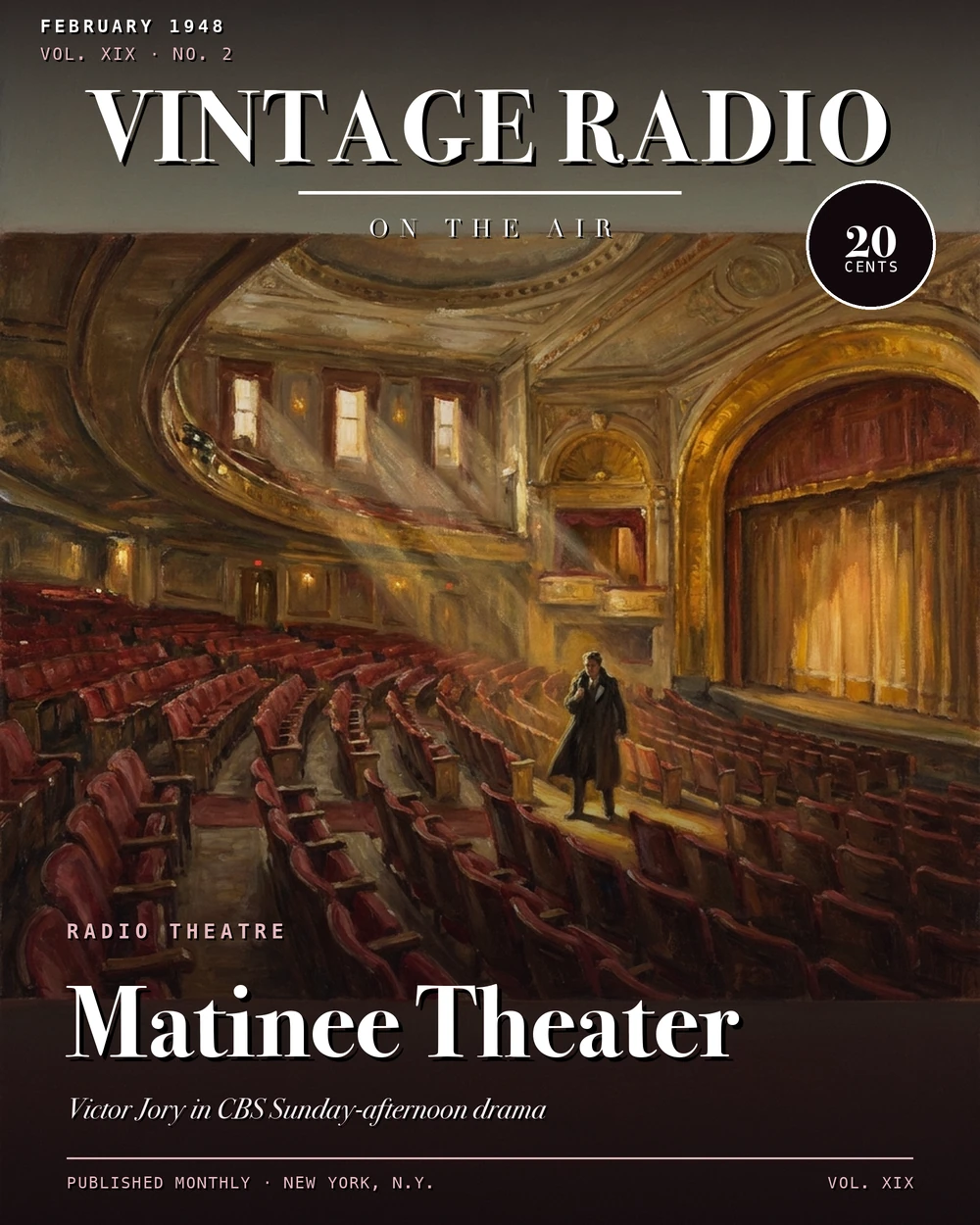
Matinee Theater
A Sunday Afternoon in Two Acts
The show that became Matinee Theater started life under a different name. From July 2 to October 15, 1944, CBS broadcast it as Dangerously Yours — a swashbuckling, romance-forward half-hour airing Sundays at 2 o'clock, sponsored by Vick Chemical Company. The premiere dramatized Alfred Noyes's poem "The Highwayman," set in the forests of England, and what followed kept that adventurous pace: "The Pirate of Orleans," "Cortez the Conquistador," "Bothwell of Scotland," Captain Henry Morgan capturing Lady Judith Lacy in "Windward Passage." Romance was always the point, though — action and adventure served as backdrop rather than engine. After sixteen episodes, CBS retitled the program, explicitly to allow "a greater range of stories."
The retitled Matinee Theater — also billed on air as Vick's Matinee Theater — ran from October 22, 1944 through April 8, 1945, and the programming shift showed immediately. Where Dangerously Yours had leaned on original swashbucklers, Matinee Theater turned to classic literary and cinematic source material: Wuthering Heights, Jane Eyre, The Scarlet Pimpernel, Rebecca, and the story of Elizabeth Barrett and Robert Browning, among others. The intended audience throughout both phases was primarily stay-at-home women on Sunday afternoons — the same demographic that kept radio soap operas running — and CBS designed the programming accordingly.
Victor Jory, Regular Star
The anchor across both runs was Victor Jory, a physically imposing presence who had been boxing and wrestling champion of the United States Coast Guard during his military service. He had trained at the Pasadena Playhouse, done a decade of stock company work, and landed on Broadway in 1929 in Berkeley Square opposite Leslie Howard. By 1944 he carried a recognizable film résumé: the villainous Injun Joe in David O. Selznick's The Adventures of Tom Sawyer (1938), Jonas Wilkerson the brutal overseer in Selznick's Gone with the Wind (1939), Oberon in Max Reinhardt's A Midsummer Night's Dream (1935), Lamont Cranston in a 1940 Columbia serial of The Shadow, and seven Hopalong Cassidy pictures between 1941 and 1943, usually cast as the heavy.
His career kept widening afterward. In 1946 he narrated Tubby the Tuba for children; the recording sold over a million copies and was inducted into the National Recording Registry in 2005. From 1959 to 1961 he played Detective Lieutenant Howard Finucane across 78 episodes of the syndicated television drama Manhunt, and in 1962 he played Captain Arthur Keller, Helen Keller's father, in The Miracle Worker. His son Jon Jory later headed the Actors Theater of Louisville for 31 years, where a performance space carries the Victor Jory name.
The Supporting Cast
Jory worked alongside New York radio regulars who brought serious credentials to the Sunday afternoon slot. Gertrude Warner, born in Hartford in 1917, served as the female lead on both Dangerously Yours and Matinee Theater before taking a similar role on Mutual's The Brownstone Theatre. Radio historian Jim Cox, writing in The Great Radio Soap Operas, called Warner someone who "may have played the leads or female leads in more dramas than any other actress" — over a career spanning 28 years and well over 4,000 performances.
Jackson Beck came from a theatrical family — his father Max had worked on stage and in silent film — and had been active in New York radio since 1931. During the 1944–1945 run of Matinee Theater, Beck was simultaneously working on at least a dozen other New York programs, including The Adventures of Superman, where from 1943 he served as the narrator-announcer intoning that show's famous opening. Martin Gabel, an original member of Orson Welles's Mercury Theatre company, had played Javert in Welles's 1937 radio Les Misérables and Professor Van Helsing in the 1938 "Dracula" broadcast that launched Mercury Theatre on the Air. Within weeks of Matinee Theater leaving the air, Gabel would host and narrate Norman Corwin's May 8, 1945 CBS broadcast of On a Note of Triumph, marking the fall of Nazi Germany.
What Survived
Two audition programs for Dangerously Yours predate the premiere: "Masquerade," recorded June 20, 1944, and "The Highwayman," recorded June 21. Of the sixteen episodes broadcast under the Dangerously Yours title, eleven survive; of the twenty-five Matinee Theater episodes — some of them repeats of earlier broadcasts — twenty-two are known to exist. The adaptations drew at least some period criticism: a reviewer examining surviving episodes noted that the Matinee Theater versions tended to sand down the tension and conflict from their source material, and the adaptation of Alfred Hitchcock's Rebecca was specifically faulted for arriving at an uncharacteristically happy ending. Whether that reflected the demands of the Sunday afternoon timeslot, the sponsor's preferences, or just the pressures of a 30-minute format, the run still represents a serious attempt by CBS to provide quality dramatic programming for its Sunday afternoon listeners.